

Programmatic advertising DSP (s) have redefined how digital campaigns are planned and executed in 2025. Instead of relying on manual negotiations, these platforms leverage automation, real-time data and AI to streamline every stage of the programmatic media buying process. The result is faster, smarter and more precise ad delivery across channels. In 2023, more than 90% of all digital display ad spend in the U.S. was transacted through programmatic technology.
Understanding how each type of programmatic advertising platform works, including the role of the programmatic advertising DSP, has become essential, as these tools now form the backbone of modern media buying. For B2B marketers, the best programmatic advertising platforms enable highly targeted, account-based campaigns that reach decision-makers by industry, company or job role—effectively turning advertising into a measurable growth engine.
The Core of Programmatic: DSP vs. SSP (A Symbiotic Relationship)
The programmatic ecosystem is centered on two complementary platforms, Demand-Side Platforms (DSPs) and Supply-Side Platforms (SSPs), which serve distinct user bases and fulfill opposite, yet complementary, functions.
1. Demand-Side Platforms (DSPs): The Essence of the Programmatic Advertising DSP
A Demand-Side Platform (DSP) is a software solution used by advertisers and media buying agencies to automate the purchase of digital ad inventory from a wide array of sources.
- Core Function: A DSP centralizes and streamlines the ad-buying process, allowing access to inventory from various ad exchanges, ad networks, and SSPs through a single interface.
- Key Mechanism: DSPs leverage Real-Time Bidding (RTB), AI-powered optimization, and precise targeting to ensure ads are placed at the right time and cost. The programmatic advertising DSP utilizes data and technology to serve ads to the most relevant users, significantly improving campaign effectiveness and return on ad spend (ROAS).
- B2B Advantage: Leading DSPs are built with B2B-specific capabilities, providing targeting based on company size, industry, job role, or decision-making authority.
2. Supply-Side Platforms (SSPs)
A Supply-Side Platform (SSP), also known as a sell-side platform, is a software solution used by digital publishers and media owners to automate the sale and management of their ad inventory.
- Core Function: An SSP connects a publisher’s inventory to multiple DSPs, ad exchanges, and ad networks simultaneously.
- Objective: Maximize the publisher’s ad revenue.
- Control and Optimization: SSPs provide publishers with control over their ad space, including setting price floors (the minimum price) and managing advertiser whitelists and blacklists to maintain ad quality and brand safety.
3. Ad Exchanges
Ad exchanges act as digital marketplaces where DSPs and SSPs connect. They are at the core of programmatic advertising explained in practice, providing the infrastructure for transparent transactions and enabling real-time auctions that allow advertisers to bid on impressions instantly.
How They Work Together: The RTB Process
The relationship between DSPs and SSPs is symbiotic, forming the backbone of RTB. The entire process occurs in milliseconds (typically under 200 milliseconds):
- A user visits a webpage with ad space.
- The publisher’s SSP initiates an auction and sends a bid request to one or more ad exchanges.
- The ad exchange broadcasts this request to multiple integrated DSPs.
- Each DSP analyzes the impression based on targeting parameters and submits a bid.
- The highest bid wins, and the ad creative is served via the DSP, through the ad exchange and SSP, to the user.

The Intelligence Layer: Data, Integration, and Hybrid Systems
Beyond the transactional core, several other platforms provide the intelligence and framework necessary for advanced programmatic strategies.
4. Data Management Platforms (DMPs)
DMPs are intelligence layers that collect, organize, and activate large sets of audience data (first-party, second-party, and third-party).
- Role: DMPs enable advertisers to build sophisticated audience segments, which are then activated in the programmatic media buying process for more accurate targeting by the DSP.
- B2B Advantage: DMPs are valuable for B2B programmatic advertising as they allow segmentation based on account-level insights, firmographics, and intent data.
5. Customer Data Platforms (CDPs)
CDPs unify first-party, identifiable customer data into a single, comprehensive profile.
- Role: CDPs track individuals across channels, supporting people-based targeting and personalization in programmatic advertising solutions. They are key to ensuring compliance with global privacy laws.
- B2B Advantage: CDPs are among the top programmatic advertising platforms for B2B marketers because they combine sales, CRM, and intent data to drive account-level personalization.
6. Ad Networks and (7.) Hybrid Programmatic Platforms
- Ad Networks: These platforms bundle publisher inventory. Ad networks predate modern programmatic advertising platforms, but many now use automation. DSPs are an evolution of ad networks, offering more advanced features regarding real-time bidding and custom audience targeting. Specialized B2B ad networks provide access to industry-specific publications and professional communities.
- Hybrid Programmatic Platforms: These solutions combine multiple platforms (often DSP, SSP, DMP, and analytics) into one integrated system, providing a unified campaign view. For B2B programmatic advertising, hybrid platforms are highly effective as they support Account-Based Marketing (ABM) and deliver measurable results across channels.
Advanced Strategy: B2B Focus and Best Practices
The selection and management of programmatic advertising dsps and SSPs must align with core business goals, audience priorities, and data strategy.
How the Programmatic Advertising DSP Drives B2B Marketing
Programmatic advertising enables B2B marketers to target and influence their ideal customer profile (ICP) with intent-driven display, social, and programmatic ad campaigns. The accuracy and scale provided by DSPs allow marketers to reach specific decision-makers and functional roles that accelerate deals and drive pipeline growth.
Practical Checklist for Choosing a Programmatic Advertising DSP
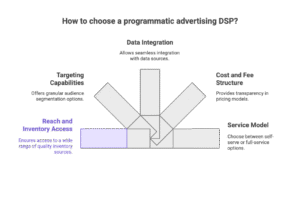
When evaluating DSP programmatic platforms, advertisers must consider key factors:
- Reach and Inventory Access: Does the DSP provide access to a wide range of quality inventory sources, including various ad exchanges and SSPs?
- Targeting Capabilities: What level of granularity does the platform offer for audience segmentation (e.g., firmographics, behavior, contextual, lookalike modeling)?
- Data Integration: Can the DSP easily integrate with your DMP, CDP, or other data sources (e.g., CRM data)?
- Cost and Fee Structure: Understand the pricing model and cost transparency.
- Service Model: Choose between Self-serve DSPs (full control, managed by advertiser’s team) or Full-service DSPs (more convenient, managed by an external team, but more expensive).
Best Practices for Publishers (SSPs)
Publishers must select an SSP that maximizes their revenue. Essential features include header bidding support, which increases competition for each impression, and granular pricing control to effectively set price floors and manage private marketplace (PMP) capabilities.
Gaps and the Future: Data Governance and Strategic Clarity
Advanced Transaction Types
While Real-Time Bidding (RTB) is central, the main types of programmatic advertising include RTB, Private Marketplaces (PMPs), programmatic direct, and preferred deals. PMPs are often utilized for accessing premium inventory outside the open exchange.
Data Governance and Compliance
Given the complexity of ad campaigns across multiple channels, Marketing Data Governance provides real-time monitoring and automated rule enforcement to safeguard marketing data across DSPs and SSPs. This is a robust solution for quality assurance, proactively detecting errors, and ensuring compliance, thus minimizing media waste and maximizing ROAS.
Unification and Analytics
Centralizing marketing data from over 500 sources—including DSPs, SSPs, DMPs, and ad servers—into a governed dataset eliminates silos and enables transparent, analysis-ready reporting.
- Practical Tip (UTMs): For large audiences spanning multiple platforms (like Facebook, LinkedIn), ensuring consistent UTM monitoring is critical to gather detailed performance data, spot trends, and identify the most effective combinations of audience, banner, message, and offer.
The Post-Cookie Landscape
The ability of the programmatic advertising DSP to continue precise targeting relies increasingly on first-party data. The CDP is therefore vital, unifying identifiable data to support people-based targeting in compliance with global privacy laws.
Programmatic as a Strategic Pillar
DSPs and SSPs are indispensable components of the programmatic advertising ecosystem. DSPs champion the advertiser’s cause by enabling targeted, efficient ad buying, while SSPs empower publishers to maximize revenue. Their intricate, high-speed collaboration ensures that digital advertising is more effective for advertisers and more profitable for publishers.
For businesses looking to navigate this complex terrain, understanding these seven platform types is the first step. The next is leveraging robust data management and governance to ensure that every advertising dollar is spent wisely, and every campaign is built on a foundation of accurate, reliable data. By doing so, B2B programmatic advertising evolves into a sustainable engine that supports long-term marketing and revenue goals.